
Your hair texture shapes almost everything about starting and keeping locs: how fast they lock, which starter method suits, how much maintenance they need, and how they behave through the settling stage. Knowing your loc hair texture, whether that’s 4C, 4B, 4A or something looser, helps you pick the right method and set realistic expectations from the start.
This guide is about the practical differences, rather than suggesting some hair is better for locs than others – so you know what to expect from yours.
Here’s how the main textures behave when you loc them, and what that means for how you start and look after your hair. Wherever your hair falls, the goal is the same: work with your texture rather than against it.
A quick word on the hair type system
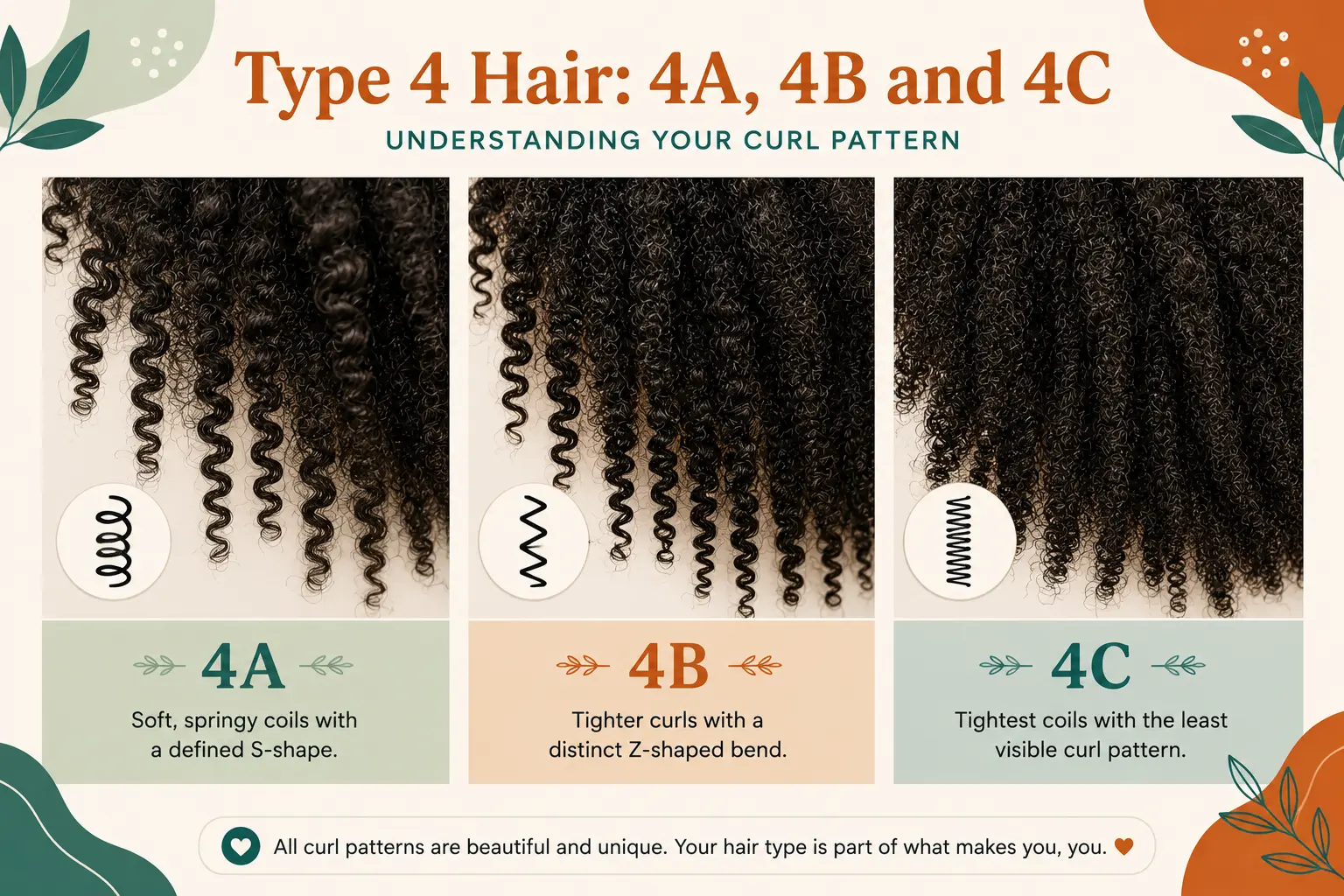
The 4A, 4B, 4C shorthand comes from a hair typing system that sorts curl patterns from straight (type 1) through to tightly coiled (type 4). Type 4 is where most loc-wearers sit, and it splits into 4A (soft, springy coils), 4B (a tighter, more Z-shaped bend) and 4C (the tightest coil, with the most shrinkage).
It’s a useful shorthand, but treat it as a rough guide rather than a rulebook. A lot of people have more than one texture across their head, and curl pattern is only part of the picture. Your hair’s density (how much of it you have), the thickness of each strand, and how much moisture it holds all affect how it locks, sometimes more than the letter you’d assign it. So use the type as a starting point, then pay attention to how your own hair actually behaves.
4C hair and locs
4C is the tightest coil pattern, and it’s the texture most loc methods were built around. It grips and knots readily, which means locs on 4C hair tend to lock the fastest and hold the most securely. It can also start on shorter hair than looser textures, because the tight coil holds its shape while the hair does the rest.
If you have 4C hair, most starter methods will work well for you, and you’ll usually move through the locking stages sooner than someone with a looser pattern.
The thing to stay on top of with 4C hair is moisture. The same tight coil that locks so well also makes it harder for the scalp’s natural oils to travel down the hair, so 4C tends towards dryness, and dry locs are more prone to breakage.
Shrinkage is the other quirk: 4C hair can look much shorter than its true length, which surprises people when their locs “grow” as they settle and the shrinkage relaxes. Neither is a problem, just something to plan for with a good moisture routine.
Because 4C locks so readily, it’s also worth knowing that separate locs can start to join at the root if you leave maintenance too long, so a bit of gentle separating between retwists keeps them defined. This is the flip side of a texture that grips well: it locks the way you want, but it will also lock the way you don’t if left entirely alone. None of this is a drawback so much as a feature to work with.
4B hair and locs
4B hair has a tight bend that’s closer to a sharp Z than a round coil, a touch looser than 4C. It shares most of 4C’s strengths for locking: it grips well, most methods suit it, and it locks fairly readily, though sometimes a little slower than the very tightest 4C.
Moisture still matters here, since 4B also tends towards dryness, and the same care applies. In practice, people with 4B hair have plenty of options for how they start and rarely struggle to get their hair to lock. The settling stage looks much the same as it does for 4C: a frizzy in-between spell before the locs bud and mature.
If your hair sits somewhere between 4B and 4C, which a lot of people’s does, don’t get too hung up on the exact label. The two behave similarly enough that the same methods and the same care work for both. The letter is a rough map, not a diagnosis, and your loctician will go by what your hair actually does, not by which category you’d tick.
4A and looser textures
4A hair has a defined, springy coil that’s looser than 4B or 4C, and this is where locking gets a little more involved. Looser curl patterns don’t grip as readily, so a simple comb coil or palm roll can slip loose before the hair has a chance to bud and lock. It’s entirely possible to loc 4A and looser hair, it just tends to take longer and often needs more help to hold.
For these textures, methods that grip the hair rather than relying on it to lock on its own tend to work better. Two-strand twists and braidlocs give more structure than coils, and interlocking holds firmly from day one, which is why it’s often recommended for looser hair that won’t hold a palm roll.
Expect a longer settling period and be ready for a bit more maintenance in the early months while the locs establish.
Can you loc looser or straighter hair?
This comes up a lot, and the answer is yes, with honesty about what’s involved. Type 3 curly hair, wavy hair and straighter textures can all be locked, but the looser and straighter the hair, the slower it locks and the more it relies on a method that grips rather than one that waits for the hair to knot on its own.
Straighter hair often does best with interlocking or the crochet method, which hold the loc together mechanically from the start, since a coil or twist has little natural texture to grab onto.
Mixed-race and multi-textured hair is very much loc-able too, and it’s common. The main thing is that a looser texture takes patience and the right technique, so it’s worth finding a loctician who has worked with hair like yours rather than assuming any method will do.
What you should be wary of is anyone promising quick, effortless locs on loose or straight hair using a method built for tight coils, because that’s how people end up with locs that won’t hold. Slower and done properly beats fast and falling apart.
Fine, soft or mixed-texture hair
Texture isn’t only about curl pattern. Strand thickness and density matter too, and fine or soft hair behaves differently regardless of its curl. Fine hair can absolutely lock, but the locs may look thinner, and the hair needs gentle handling because it’s more prone to breakage under tension. Sizing matters here: sections that are too small on fine hair leave weak, thin locs, so bigger sections often serve fine hair better.
Mixed textures are common, where the crown might be a tighter coil than the nape, or the front softer than the back. When your hair locks at different speeds across your head, some areas mature while others are still settling, which is normal and evens out over time.
A good loctician will adjust the method and sizing across your head rather than treating it all the same, so the softer or looser patches get the extra structure they need to hold.
How texture affects lock speed and method
Pulling it together, here’s the rough picture. Treat it as a guide, since your density, strand thickness and moisture all shift things.
| Texture | How readily it locks | Can start short? | Methods that tend to suit |
|---|---|---|---|
| 4C | Fastest, holds strongly | Yes | Most methods, including comb coils |
| 4B | Locks readily | Usually | Most methods |
| 4A and looser | Slower, needs more help | Needs a bit more length | Twists, braidlocs, interlocking |
| Fine or soft | Locks, but handle gently | Depends on curl | Larger sections, gentle tension |
Moisture and care by texture
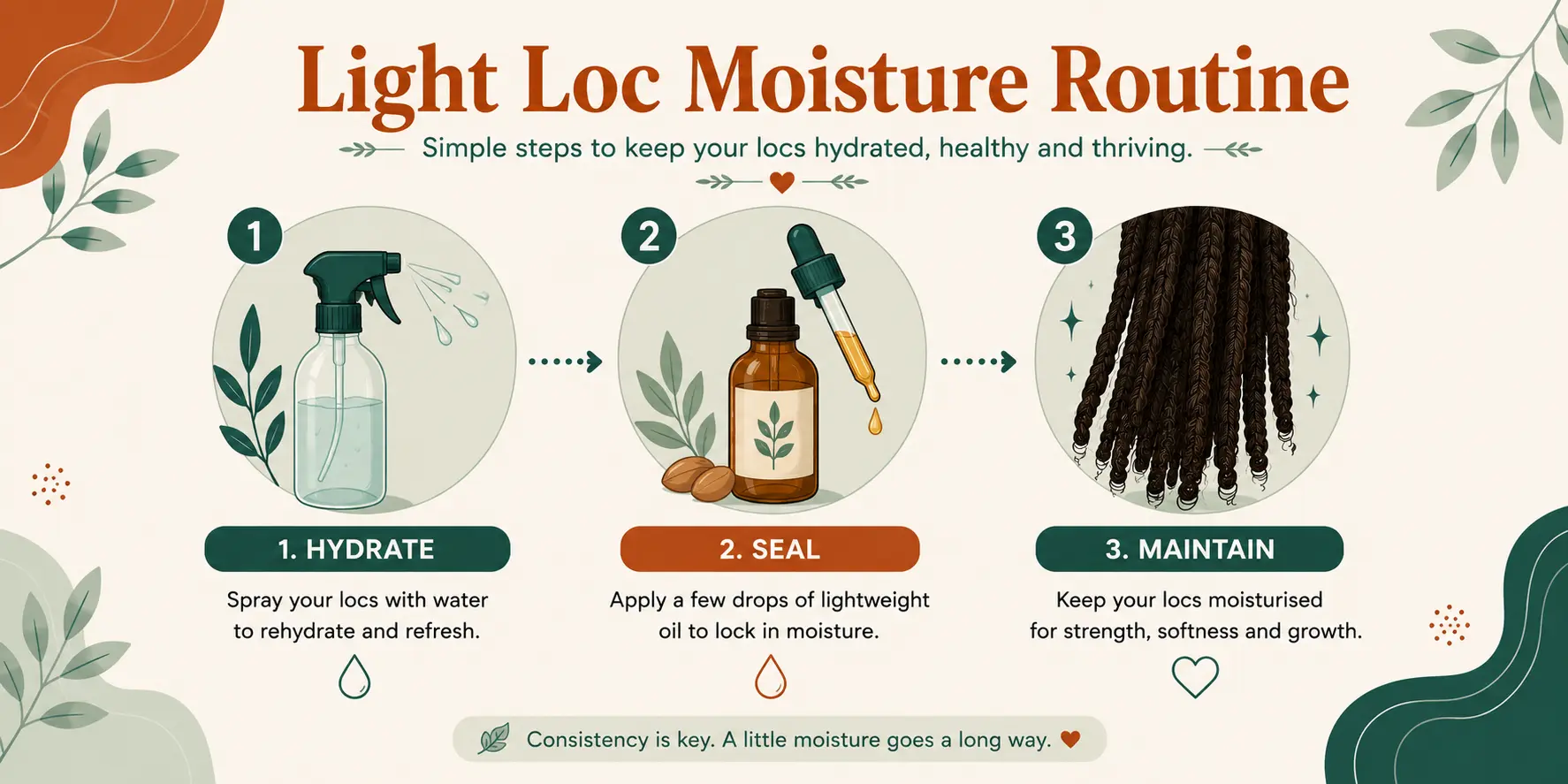
Whatever your texture, the same principle holds: keep it clean and lightly moisturised, and go easy on heavy products.
But the emphasis shifts a little depending on your hair, and getting the moisture side right is often the difference between locs that stay strong and locs that dry out and snap at the ends.
Tighter textures like 4C and 4B lean towards dryness, so a regular light moisture routine matters more, water first and then a little oil that absorbs rather than sits on top.
Looser and finer textures often hold moisture more easily but can be more fragile, so gentle handling and not over-tightening the roots is the priority there.
Across all textures, washing properly and drying fully matters, and heavy waxes and butters cause more problems than they solve. When you’re ready for the full method, our guide to washing locs properly walks through it.
Choosing a starter method for your texture
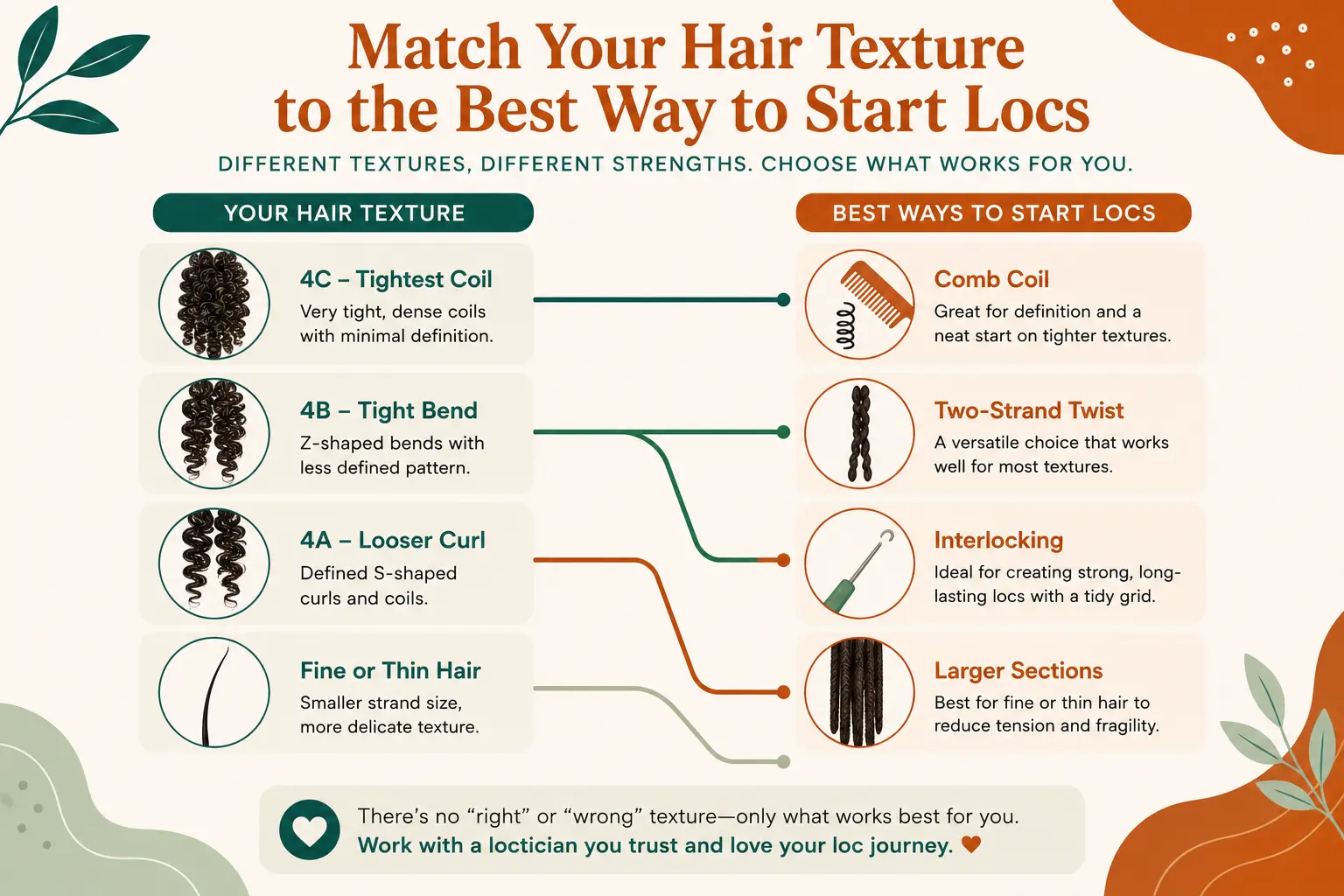
Your texture points you towards the right way to start. Tighter 4C and 4B hair holds coils and twists well, so you’ve got the full range of methods to pick from.
Looser 4A and softer hair does better with the methods that add structure or grip, twists, braidlocs or interlocking, rather than a plain coil that might slip.
Fine hair wants gentler handling and slightly larger sections whatever the curl.
So, match the method to what your hair does, not to what looked good on someone else, and you give your locs the best possible start.
None of this is fixed, and the best way to know for sure is to have a loctician look at your actual hair, since the letter you’d give your texture only tells part of the story.
For how each starter method works and what it looks like as it settles, see our comparison of comb coils vs two-strand twists vs braids, and for the maintenance side, interlocking vs palm rolling vs crochet.
If you’re weighing up the whole process, our guide to starting locs in the UK brings it together from method choice through to the first year.
It’s also worth setting expectations on time. Because texture drives how quickly hair locks, two people who start on the same day with the same method can be at very different stages six months in, purely because one has tighter hair than the other.
If your locs seem slower than someone else’s you’ve seen online, the difference is almost always texture, not anything you’re doing wrong. Judge your own progress against your own hair, and give looser or finer textures the extra patience they need.
The short version: there’s no hair too curly, too soft or too anything for locs. Some textures lock faster and some need more patience and the right method to hold, but with the right start, any type 4 hair, and plenty of looser hair too, locks beautifully.


