There’s no licence for being a loctician in the UK. No mandatory qualification, no exam, no register you have to join before you can charge for a retwist. If you’ve been reading American advice about getting “licensed”, none of it applies here.
What you actually need is training, practice on real heads, insurance, and clients who trust you. This guide covers how people get there, what UK loctician courses cost, and how long it takes before you can call yourself the real thing.
Do you need a qualification or licence to be a loctician in the UK?
Legally, no. Hairdressing in the UK is an unregulated trade. The House of Commons Library briefing on hairdressing regulation confirms there’s no statutory requirement to hold any qualification before working on someone’s hair, locs included.
There is a UK register of qualified hairdressers, run by the Hair Council under the Hairdressers (Registration) Act 1964, but joining is voluntary. It costs £70 a year and most working stylists aren’t on it. The Hair Council has campaigned for years to make registration compulsory; as of mid-2026, Parliament hasn’t acted.
So why do so many search results talk about certification and licensing?
Because they’re American. Several US states require natural hair practitioners to hold a state licence, and that framing leaks into UK Google results.
In the UK, a “certified loctician” means someone who holds a certificate from whoever ran their course. The certificate is only as good as the training behind it. “Master loctician” is the same: a description some experienced locticians use, not a regulated title anyone awards.
One legal point that does apply: if you open a salon or rent a space, some councils in England require hairdressing premises to be registered for health and safety. It’s the premises, not you, and it’s a registration rather than a qualification. Check with the local council, or start with the GOV.UK guidance. Mobile and home-based locticians generally don’t need it, though it’s still sensible to confirm locally.
The three routes in
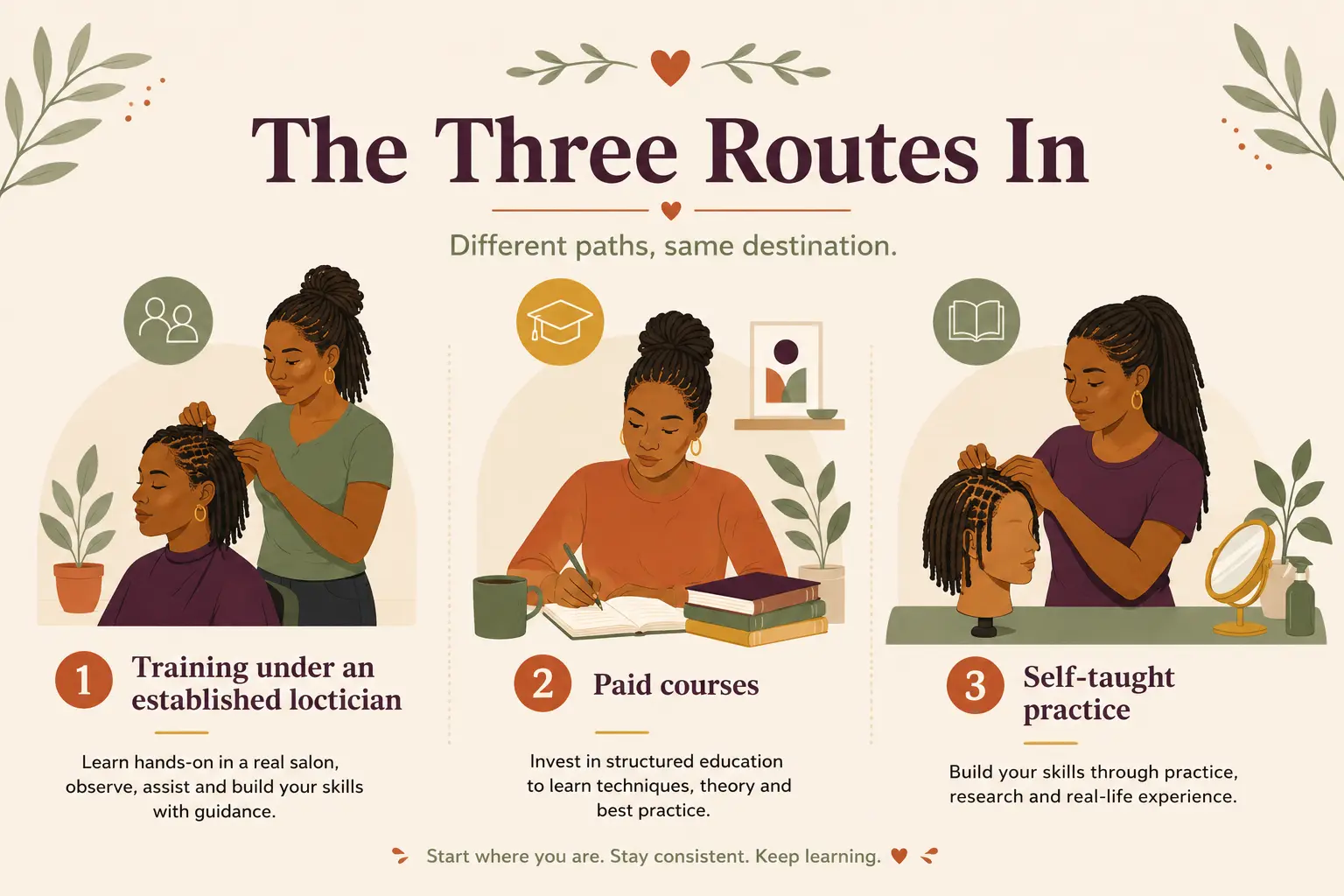
Nobody hands out a map for this trade. But almost every working loctician in the UK got there by one of three routes, usually a mix of two.
Training under an established loctician
This is the strongest route, but the hardest to arrange. Assisting in a busy loc salon, even informally, teaches you things no course can:
- how to handle a client whose roots are thinning
- how to quote for a full day of repairs
- what to say when someone arrives wanting their locs combed out
Some salons take on assistants or apprentices quietly, through their own networks rather than job adverts. If there’s a loctician whose work you rate, ask. The worst answer is no, and a respectful message that shows you’ve studied their work gets read.
Paid courses
This is the most common starting point.
UK loc courses run from one-day group sessions to four-day intensives, and prices range from about £250 to £1,000. They compress years of trial and error into days:
- sectioning patterns
- starter loc methods
- retwisting
- interlocking
- what products do and don’t belong near locs
What they can’t compress is hand speed and judgement. A course gets you to competent-on-a-mannequin; only repetition gets you to confident-on-a-person. The good providers say this out loud and set assignments after the course ends.
Self-taught practice
A lot of locticians start this by teaching themselves, with no course involved: by doing their own hair, then a sibling’s, then friends of friends, learning from YouTube and correcting mistakes as they go. It’s free, and it builds real skill.
However, its limits can begin to show up over time.
Self-taught locticians tend to know one head of hair very well and often get caught out by textures and densities they haven’t handled. They also tend to underprice for years, because nobody taught them the business side of things.
If you start this way, a course or a day shadowing an experienced loctician is likely to fill the gaps faster than another year of solo practice.
Loctician courses in the UK: what they cost
Prices below were checked in June 2026. Confirm dates and fees directly with each provider before booking, since small training businesses change their schedules often.
RastamamaLocs runs a one-day group loctician training in London for £250, covering comb coils, crochet and interlocking starter methods plus retwisting, repairs and extensions, with tools included and a certificate of completion at the end of the day. They also offer one-to-one and two-day intensive options.
The Loc Pod in Hackney Wick teaches a three-day one-to-one masterclass covering starter locs, retwists, interlocking and instant locs, with six months of mentorship afterwards. Pricing is on application, and you apply rather than simply book, which tells you something about how seriously they filter students.
ThreadLOXX in Barnstaple, Devon, runs a three-day course at £599 built around the crochet method, with a take-home training head, a set assignment after the course, and an invitation back for a one-day assessment a few months later.
CrafterElena in Kendal, Cumbria, offers a four-day professional loctician course at £1,000 including a starter kit, focused on crochet-method locs and extensions, with homework to complete before the diploma is issued.
Two things to weigh up beyond price.
First, hair type. Some UK courses, particularly the crochet-method ones, are built around creating locs in straighter European hair textures, while others are rooted in Afro-textured hair care. They’re different skill sets.
Train for the heads you’ll actually be working on, and if you want to serve everyone, make sure your training covers type 4 hair properly rather than treating it as a footnote.
Second, what happens after the last day? The difference between a course and a certificate mill is usually the aftercare: set assignments, mentorship, a WhatsApp group where you can send photos of a tricky head and get an answer.
A one-day course with six months of support beats a week-long course that ends at the door.
A few questions to ask any provider before you pay a deposit:
- How much of the time is hands-on, and on what: mannequins, models, or both?
- How many students per trainer?
- Which hair types does the training actually cover?
- What support do you get after the course ends?
- Can you speak to a past student?
What about online loctician courses?
They exist, mostly from US providers, and they’re fine for theory: loc stages, product knowledge, consultation skills. But locs are a physical craft. You can’t learn tension control from a video any more than you can learn to swim from one.
If budget is the constraint, a £250 one-day group course with your hands in real hair teaches you more than £250 of recorded modules.
How long does it take to become a loctician?
The honest answer comes in three stages.
Learning the techniques takes days to weeks. A short course covers starter methods and retwisting, and most people are doing passable retwists on familiar heads within a month of focused practice.
Becoming competent takes months. Plan on roughly six months of regular practice before you can handle different textures, densities and loc sizes without supervision, and price a job accurately by looking at it. Retwists come first for almost everyone, then starter locs, then the harder work of repairs, extensions and instant locs.
Most locticians charge for retwists relatively early, often at a reduced rate while building speed, and add services as their confidence earns it.
Building a full book of clients takes a year or more. That’s not a skills problem; it’s maths: clients on a six-to-eight-week retwist cycle mean you need fifty-plus regulars before the diary looks full. The locticians who get there fastest are the ones whose early clients rebook and refer, which is a quality problem after all.
Setting up: the unglamorous essentials
Three pieces of admin separate a hobby from a business, and none of them is expensive.
Public liability insurance comes first, before your first paying client. If a client reacts badly to a product or trips over your kit bag, this is what stands between you and a personal bill.
Policies for self-employed and mobile hair stylists start around £35 to £100 a year from providers like Simply Business, Insync or Salon Gold. Check the policy covers treatment risk (work you do on the hair itself), not just accidents around your kit.
Tax registration is simpler than people fear. Once you earn more than £1,000 from self-employment in a tax year, you register for Self Assessment with HMRC as a sole trader.
It’s free, done online, and under the £1,000 threshold you don’t need to register at all. Keep records of what clients pay you and what you spend on products and tools from day one; it makes the first tax return painless.
Then there’s where you work.
- Mobile (you travel to clients) costs the least to start and suits a first year well.
- Renting a chair in an existing salon typically runs £100 to £200 a week in most UK cities, more in London, and makes sense once your diary is full most weeks.
- Working from home sits in between; check your tenancy or mortgage terms and, if you’re seeing a steady stream of clients, whether the council has a view.
Most locticians start mobile or from home and move into a chair when demand justifies the rent.
Getting your first clients
Your portfolio matters more than your certificate, because clients can see it. From your first practice heads onwards, take clean before-and-after photos, in daylight, with the client’s permission, and post consistently. Instagram is the shop window for loc work in the UK; a grid that shows neat partings and healthy roots does more selling than any bio line.
Word of mouth carries the rest. Early on, every satisfied head is a walking advert on a six-week rebooking cycle, so look after the clients you have before chasing the ones you don’t. Clear prices, honest timings and a follow-up message a week after a starter install cost nothing and get remembered.
And once you’re taking clients, put yourself where people are already searching. A free listing on Loctician puts your work in front of people looking for a loctician in your city by the services you offer, from starter locs to retwists. It only takes a few minutes, and there’s no charge.
You won’t be the finished article when you take your first paying client. Nobody is.
Train properly, practise more than feels necessary, insure yourself, and let the quality of your work do the talking. The UK has far more people wearing locs than locticians who can care for them well.
There’s room for you.