
One of the hardest parts of having new locs is not knowing whether what you’re seeing is normal. This loc journey timeline walks through what to expect month by month, from the day your locs go in to somewhere around the two-year mark when they’re fully settled.
The short version: locs move through recognisable stages, the middle ones look messy, and your hair texture decides the pace, so treat the months here as a guide rather than a promise.
If you take one thing from it, let it be that the frizzy, unsettled phase in the middle is the process working, not failing. Almost everyone who loves their mature locs went through months of wondering whether theirs were going wrong. They weren’t, and yours probably aren’t either.
Knowing roughly what each stage looks like ahead of time is the best way to stop the awkward months from catching you out.
The loc journey timeline at a glance: the five stages
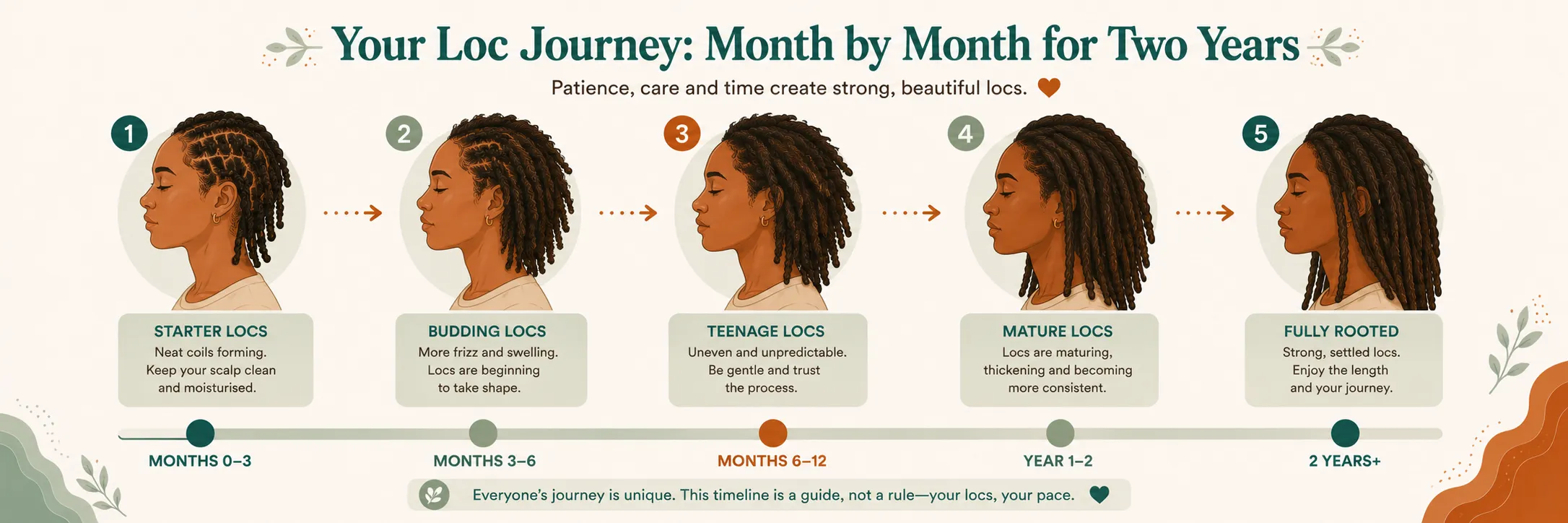
Locs are usually described as moving through five stages. Here they are in a line, before we go through them month by month:
- Starter: fresh coils, twists or braids, still clearly showing the method they were made with.
- Budding: the frizzy “ugly stage” where the hair starts to knot and swell inside the loc.
- Teenage: locking but unpredictable, doing their own thing.
- Mature: dense, compressed, hanging with weight and looking the way you pictured.
- Rooted: fully settled, and simply part of you.
Nobody moves through these on a fixed schedule. Tighter, kinkier hair tends to move faster; looser or finer hair takes longer.
The months below are a common pattern, not a rule, so read them as a rough map of what’s coming rather than a countdown.
Months 0 to 3: the starter stage
Your locs are brand new, and they still look like whatever method started them, neat coils, defined twists or a plaited pattern. This is the most fragile stage, so most of the work here is leaving them alone.
What’s normal: the starter pattern staying visible, a bit of frizz creeping in towards the end of this stage, and roots that need retwisting to stay tidy.
What’s not: whole locs sliding loose, which usually means they’ve been washed too soon or handled too much.
The key habits are gentle, careful washing on your loctician’s schedule, a satin or silk bonnet at night, and not retwisting too often or too tight.
If you’re finding the early aftercare confusing, our guide to starting locs in the UK covers it in full, and the retwisting question, which trips a lot of people up early, is covered in how often to retwist your locs.
The temptation in these first weeks is to fuss over your locs and retwist them constantly for neatness. Resist it. A little frizz now is harmless; over-handling fragile starter locs is not.
Within this stage, the first month is the most delicate. Depending on your method and texture, your loctician may want you to wait a week or two before the first wash so the coils or twists have a chance to set.
By the second and third months you can usually wash a little more freely, and you’ll start to see the first hints of frizz that mark the move into budding. That frizz is a good sign, not a bad one: it means the hair is starting to shift and knot rather than just sitting in its set shape.
Months 3 to 6: budding, the “ugly stage”
This is the stage people find hardest, and the one that catches everyone off guard. Your locs start to frizz, puff up and look unsettled, and the neat starter pattern breaks down. It can feel like they’re falling apart. They’re not. What’s happening is that the hair inside each loc is beginning to knot and mat together, which is exactly what locking is. It just doesn’t look tidy while it’s going on.
Expect frizz along the length, some locs looking fatter or lumpier than others, and ends that haven’t sealed yet. All normal.
This is the phase where a lot of people panic, over-retwist, or think about taking their locs out, and the single best thing you can do is nothing dramatic: keep washing, keep the tension gentle, and let them go through it.
The budding stage is the toughest stretch to sit through and the clearest sign your locs are doing what they should.
If your scalp gets itchy or flaky during this stage, which is common, that’s usually build-up or dryness rather than anything to do with the locking, and our post on an itchy scalp with locs covers what helps.
How long does the budding stage last?
There’s no fixed answer, which is part of what makes it hard.
For most people the budding stage runs through roughly months three to six, but it can be shorter on very tightly coiled hair that locks quickly, or drag on past six months for looser or finer textures. You’re through it when the frizz starts to settle and the locs begin to feel firmer and less inclined to unravel.
The stage feels longer than it is because it’s uncomfortable to look at your own hair and feel it’s not going well. It helps to take a photo every month or so rather than staring in the mirror daily, since the change is slow and easier to see over weeks than days. Comparing this month to two months ago will usually show you progress the daily view hides.
Months 6 to 12: the teenage stage
Once the budding settles, locs move into what’s often called the teenage stage, and the name fits. They’re properly locking now, but they behave unpredictably: sticking out at odd angles, some maturing faster than their neighbours, a few still frizzy while others have started to firm up. Your locs have a mind of their own for a while.
This stage tests your patience more than your care routine. The frizz slowly reduces, the locs start to gain a little weight, and things gradually even out, but not on any schedule you can hurry.
What helps is consistency: regular gentle washing, sensible maintenance, and resisting the urge to chase perfection with tight retwists or heavy styling. Locs that are left to mature with light, consistent care almost always end up healthier than ones that were fussed over.
Towards the end of this stage you’ll notice locs beginning to feel firmer when you squeeze them, and less inclined to unravel at the ends. That’s the sign they’re heading into maturity.
The teenage stage is also when a lot of people start experimenting a little, trying simple styles or accessories. That’s fine in moderation, but keep anything that pulls on the roots light and occasional, since the hair is still establishing and tight styles can undo progress or stress the hairline.
If you can hold off on heavy styling until your locs are more settled, they’ll thank you for it. This is a stage to ride out more than to intervene in.
Year 1 to 2: maturing and rooted
Somewhere in the second year, most people feel their locs become truly mature. They gain weight and hang with it, feel dense and compressed rather than fluffy, and the ends seal and settle.
The frizz that defined the middle stages calms right down, and your locs finally look and feel the way you pictured when you started.
The rooted stage is the last one, when your locs are fully settled and low-drama. Maintenance gets easier here, since mature locs hold their shape on their own and need retwisting far less often, mostly for tidiness rather than to keep them together.
This is the payoff for sitting through the earlier stages: locs that are simply part of you and ask very little in return.
When people say locs mature between twelve and twenty-four months, this is the window they mean, with the firm caveat that texture moves the goalposts. Tighter hair often gets here sooner, and looser or finer hair later, so don’t measure your locs against anyone else’s calendar.
Maturity isn’t a single moment, either.
Your locs won’t all cross the line on the same day; some will feel mature while others are still firming up, and the ends are often the last part to fully seal.
Over the second year they gradually even out, get heavier, and settle into their final character.
Many people find their locs keep improving well beyond two years, gaining length and a lived-in quality that only time gives. The two-year mark is less a finish line than the point where the hard part is behind you.
Can you speed up the process?
Not really, and trying to usually backfires. The instinct is to retwist more often or manipulate the locs to hurry them along, but that adds tension and stress without making the hair lock any faster.
Locking happens on its own timescale, set mostly by your texture, and there’s no product or technique that safely fast-tracks it.
What you can do is avoid slowing it down.
Over-washing with heavy conditioning products, too much oil and wax, and constant retwisting all work against clean, healthy locking.
The fastest route through the stages, ironically, is the low-effort one: wash regularly with a residue-free product, keep the tension gentle, and otherwise leave your locs to get on with it.
People who obsess over their locs tend to have a harder time than people who set a simple routine and stick to it.
What changes the timeline
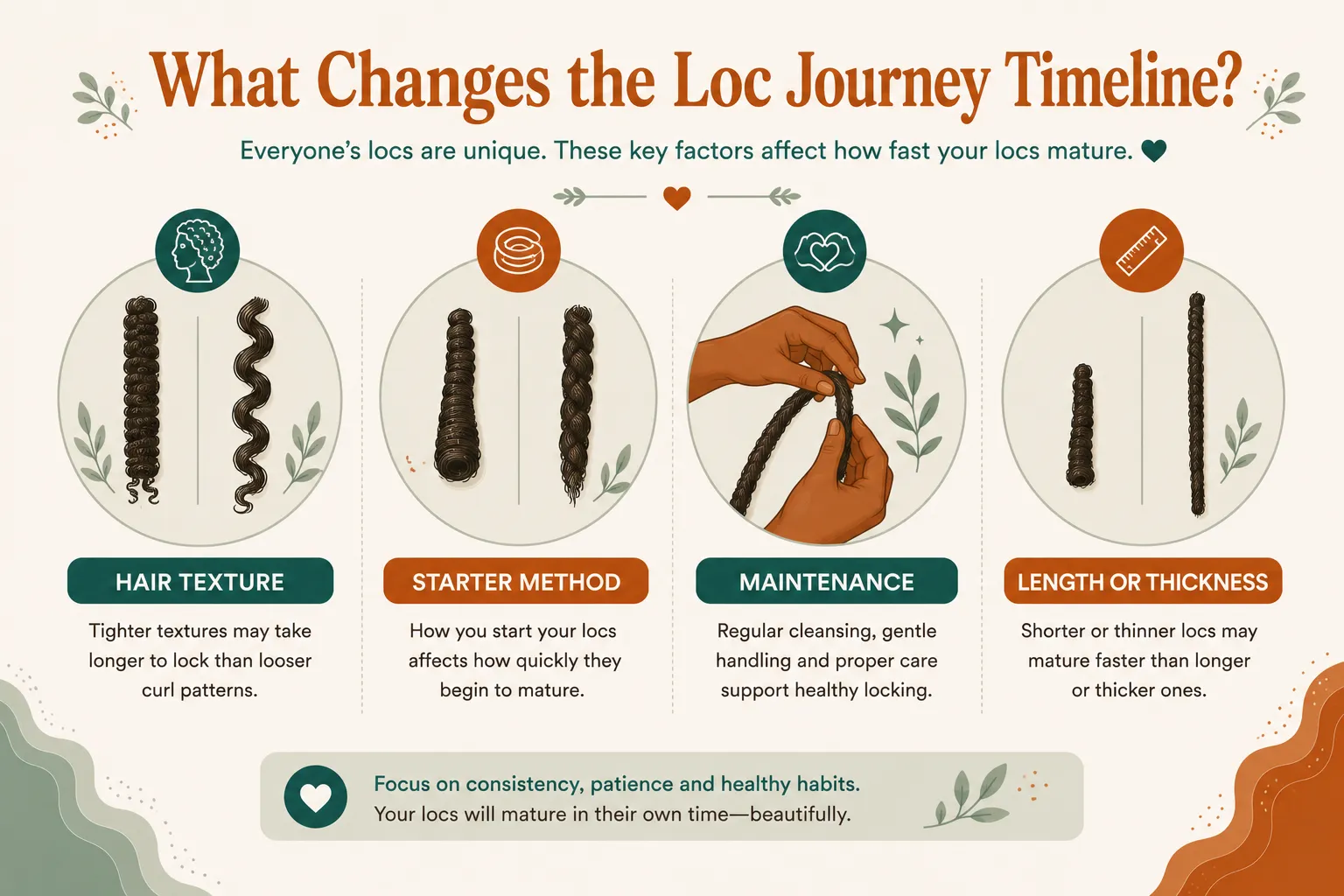
A few things decide whether your locs move quickly or slowly through all this:
- Texture. The biggest factor by far. Tighter, kinkier hair locks faster and firmer; looser and finer hair takes longer. Our guide to hair texture and locs goes into how 4A, 4B and 4C behave.
- Starter method. Some methods hold their pattern longer than others, which shifts how the early stages look. See comb coils vs two-strand twists vs braids for how each settles.
- Maintenance. How you wash, how often you retwist, and how gentle the tension is all affect how smoothly your locs mature.
- Length and thickness. Longer, thicker locs hold more water and can take longer to lock through and dry, which nudges the timeline out a little.
Because of all this, two people can start on the same day with the same method and be at very different stages six months later, purely down to their hair. That’s normal. Judge your progress against your own hair, not a video you saw online.
Signs something’s off, not just a stage
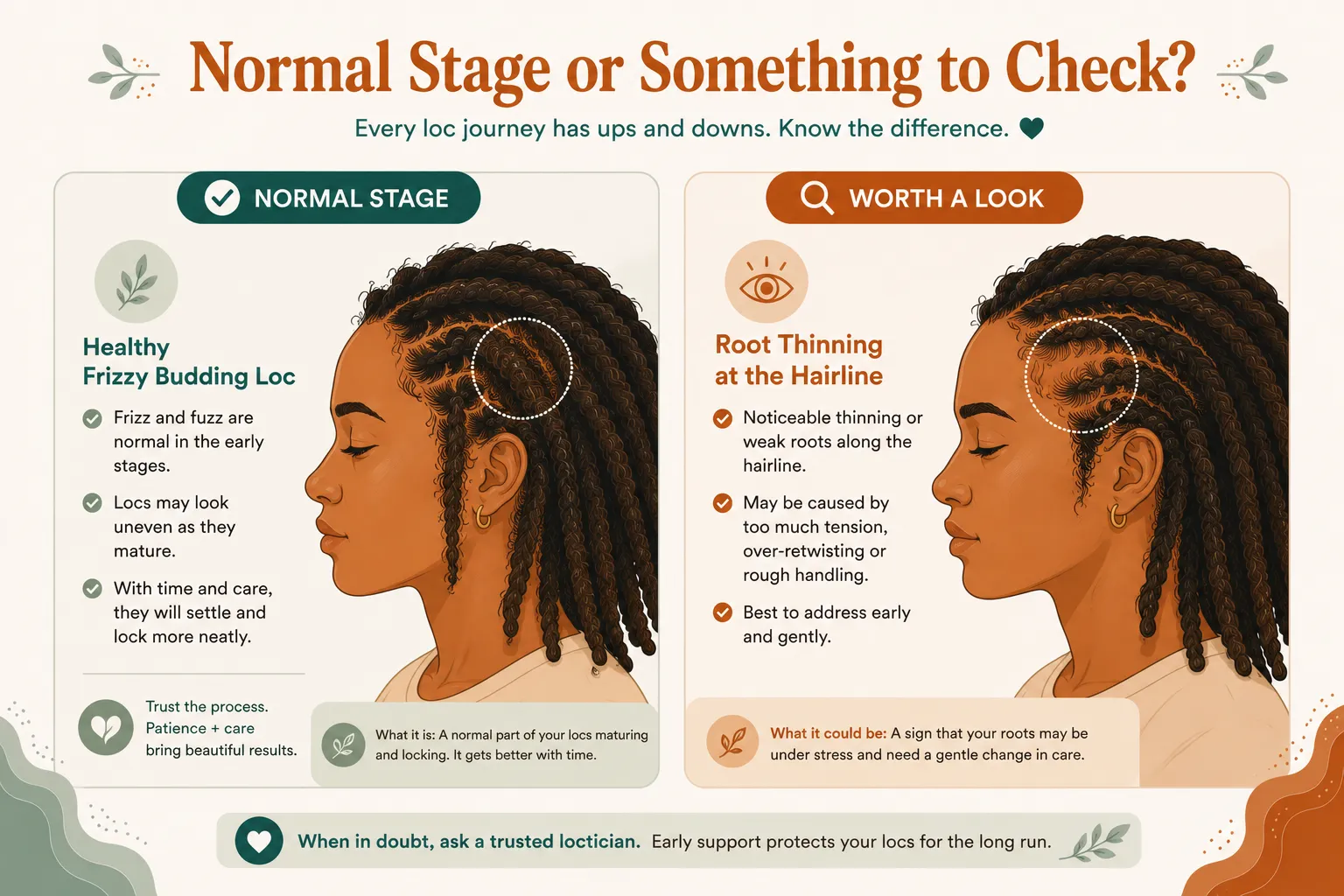
Most of what looks alarming in the first year is just a stage. But a few things are worth taking seriously rather than waiting out, because catching them early makes them easier to fix.
Keep an eye out for persistent thinning where the loc meets the scalp, a loc that keeps coming apart in the same spot, breakage at the roots, or a hairline that’s receding. These often trace back to retwisting too tight or too often rather than to the natural locking process.
If you notice any of them, ease off the tension and read up on thinning roots and loc breakage, which cover how to protect and recover your hair.
Scalp problems that don’t settle with better washing are the other thing to act on.
Ongoing heavy flaking, soreness or redness is worth a word with a professional rather than another bottle of oil, and thorough, regular washing prevents most of it in the first place. Our guide to washing locs properly walks through the method.
The rest of the time, the honest advice for the whole loc journey timeline is the same: wash well, keep the tension gentle, retwist less than you think you need to, and be patient through the messy middle.
Locs reward people who leave them to do their thing, and the awkward stages you’re worrying about now are exactly the ones you’ll barely remember once your locs are rooted.