Deciding how to start locs comes down to three decisions: which method to use, whether to go to a loctician or start at home, and how you’ll look after them while they lock. There’s no licence for any of it and no single right way to do it. But some choices are a lot easier to live with than others, and a few early mistakes are hard to undo.
This guide covers how to start locs in the UK from every angle, the way a good loctician would talk you through it at a consultation. It walks through the starter methods and who each one suits, what length your hair needs to be, what a starter set costs right now, and what the first weeks and months actually look like once you’ve got them in. Where a topic deserves its own deep dive, we link out to it rather than cramming everything in here.
First, the honest bit: what starting locs commits you to
Locs are a long-term style. That’s the whole appeal for most people, but it’s worth saying plainly before you start, because it changes how you should think about the first few decisions.
Once your hair has locked, you can’t just brush it back out the way you would get a fresh twist out.
Taking mature locs down means either combing them out strand by strand, which is slow and costs you a lot of length, or cutting them off and starting your hair again. Neither is a disaster, and plenty of people do change their mind further down the line. But you’re not choosing a look for a season. You’re choosing one for years.
The other thing nobody tells you often enough: locs don’t look “finished” on day one, and for most methods they won’t for months. Coils, twists and palm-rolled locs go through a settling stage where they frizz, puff up, unravel a little and generally look like they’re in between things, because they are.
This is normal and temporary, and we’ll come back to it, but if you’re expecting the neat, rounded locs you saw on Instagram to appear the week you start, you’ll be disappointed. Those took a year or two.
It’s also worth being clear-eyed about maintenance from the outset. Locs aren’t a wash-and-go style in the way people sometimes assume. They need regular upkeep to keep the roots neat, washing done properly, and a bit of care at night, and that carries on for as long as you have them.
The upkeep is straightforward once you’re in a rhythm, but it is ongoing, so factor it into your thinking now rather than being surprised by it later.
None of this is a reason not to start. It’s the context that makes the rest of the choices make sense. If you know going in that this is a long-term style with an awkward middle stretch and a steady maintenance habit, you’ll pick a method you can live with, look after it properly, and give it the time it needs.
Most people who love their locs will tell you the early stages were the hardest part and that it was well worth staying the course.
What length does your hair need to be?
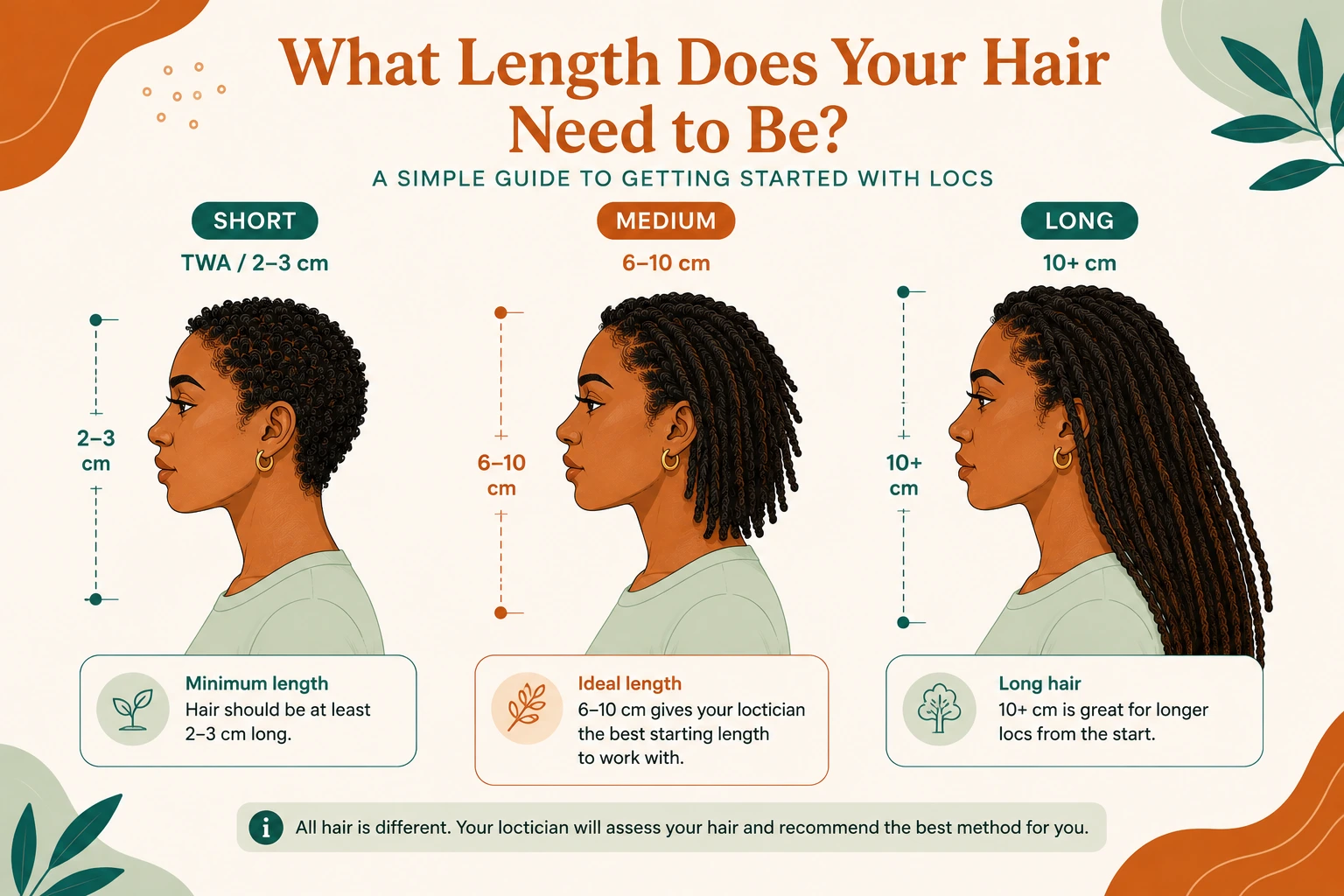
This is usually the first practical question, and the honest answer is that it depends on your method and your texture, but there’s a workable rule of thumb.
Most locticians want somewhere around 5 to 15cm to work with, roughly 2 to 6 inches. On tighter textures you can get away with less; on looser ones you’ll want more.
Comb coils and two-strand twists (sometimes written two strand twists) can start on shorter hair, sometimes as little as 5cm on very coily hair, because the curl pattern holds the shape while the hair does its thing.
Palm rolling and interlocking generally want a bit more length so there’s enough hair to grip and hold the form.
Can you start locs on short hair? Yes, and it’s one of the most common questions. Short hair is no barrier, as long as there’s enough for the loctician to section and set. On tightly coiled hair a comb coil holds at just a couple of inches, which is why coils are the usual pick for shorter hair. The main thing with a short start is patience: the shorter you begin, the longer the locs take to look established, so expect a while before they hang.
If your hair is very short, a consultation will tell you whether to start now or grow it another month or two first.
Texture matters as much as length. Kinkier hair, the sort often described as 4B or 4C, locks faster and binds more tightly, so it can start shorter and settle sooner. Looser curl patterns and softer, finer hair take longer to lock and usually need a little more length to start with, because there’s less natural coil holding everything together in those early weeks.
If your hair is relaxed or heat-damaged at the ends, most locticians will want that grown out or trimmed off first, since locked hair and straightened hair don’t behave the same way.
If you’re not sure whether your hair is ready, that’s exactly the sort of thing a loctician will tell you honestly at a consultation. A good one will happily say “give it another couple of months” rather than start you too soon and set you up for locs that unravel.
There’s more on how texture affects the whole process in our guide to hair texture and locs.
Can you start locs on any hair type?
More or less, yes, but not every hair type locks the same way, and it’s worth being realistic about that before you book.
Type 4 hair, with its tight coil pattern, is the most straightforward to lock and the texture most loc methods were built around. It grips, holds a coil and buds up on its own with the least encouragement.
Looser curl patterns, wavy hair and fine or soft hair can absolutely be locked, but they take longer and often need more help along the way.
Softer hair may need interlocking or the crochet method to hold, because a simple coil can slip loose before it has a chance to bud.
If your hair is very straight, expect a slower process and be wary of anyone promising quick results with a method that suits coily hair.
Relaxed or heat-damaged hair is the one real sticking point: the treated sections won’t lock like natural hair, so most locticians will want that length grown out or cut off first so your locs start from healthy, natural hair.
If you’re weighing up your own texture, the hair texture and locs guide goes deeper on 4A, 4B and 4C hair specifically.
The starter methods, and how to choose
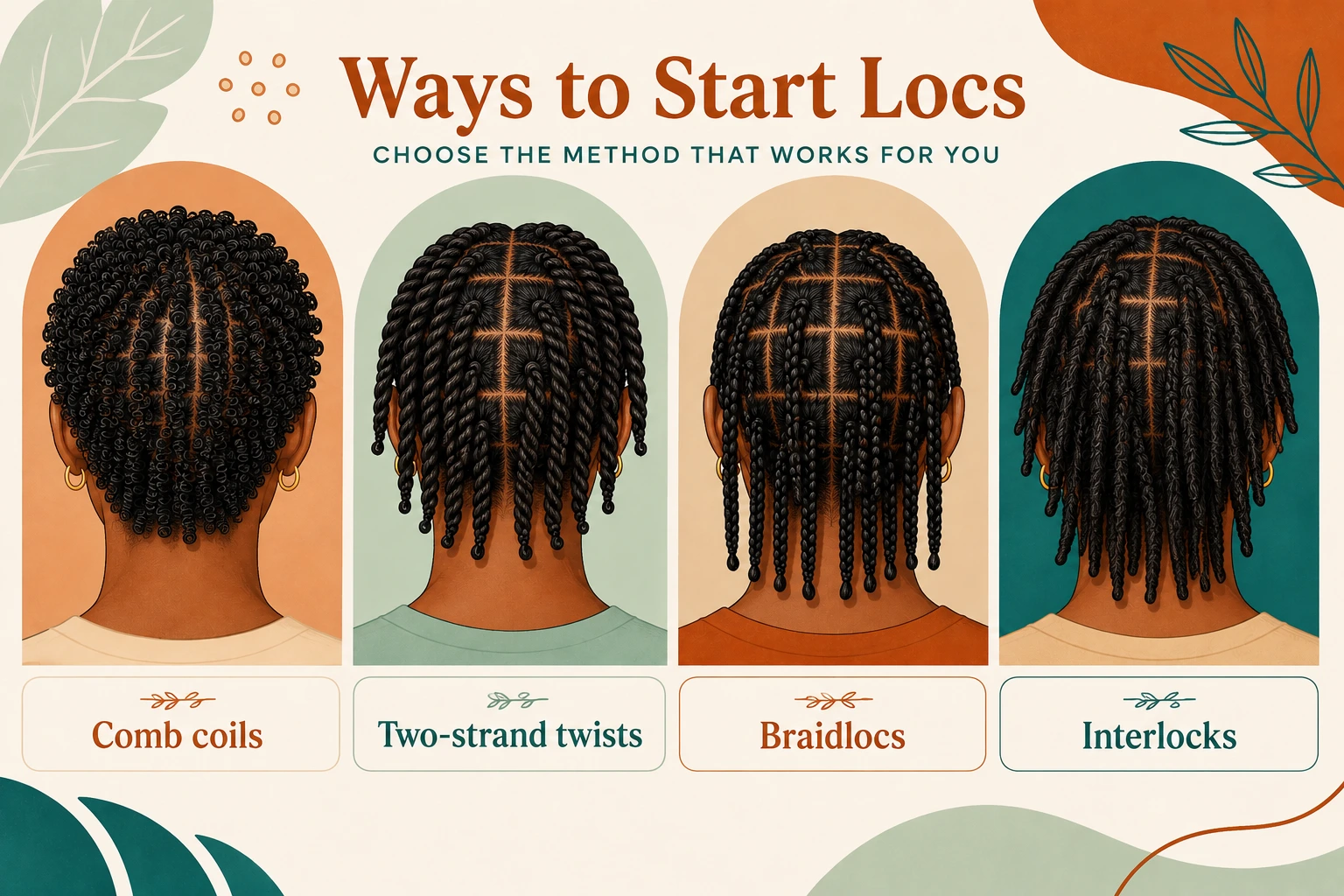
There are several ways to start locs, and the right one is mostly a question of your hair texture and the look you’re after, not which method is objectively best. There isn’t a best method. There’s the one that suits your hair and your patience.
Here’s what each one is and who it tends to work for.
Comb coils
The most common starting point, especially for shorter hair. The loctician sections your hair into a grid, then uses a fine comb to coil each section into a small spiral that sits close to the scalp. Coils suit tighter textures well and can start on relatively short hair.
They go through the full settling stage, so expect frizz and some unravelling in the early weeks before they begin to bud and lock. Gentle on the hair, and a solid default if you’re not sure where to start.
Two-strand twists
Your hair is parted into sections, and each section is split in two and twisted around itself. Twists give a slightly thicker starter loc than coils and tend to suit medium to longer hair, or hair with a bit more length to play with.
Like coils, they take weeks to months to lock and pass through the frizzy in-between stage. A lot of people who start at home go with twists because they’re straightforward to do on your own hair.
We compare coils, twists and braid starts in more detail in comb coils vs two-strand twists vs braids.
Palm rolling
Rather than coiling or twisting, the hair is rolled between the palms to encourage each section into a cylinder. Palm rolling gives a smoother, rounder starter loc than coils and is often used for maintenance later on too.
It usually wants a little more length than coils to hold well, and, like the other gentle methods, it takes time to settle. If you like the look of a neat, rounded root, this is often the way there.
Interlocking
A different approach entirely. Instead of encouraging the hair to lock on its own, the loctician pulls the end of each loc back through its own base with a tool or fingers, so it holds tight from the very first day.
Interlocked locs skip most of the frizzy settling stage and hold well through washing and swimming, which is why some people prefer them.
The trade-off is that interlocking done too tightly or too often can stress the hair and thin the roots over time, so it needs a careful hand. It also tends to cost more.
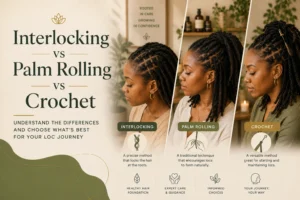
There’s a full breakdown of the trade-offs in interlocking vs palm rolling vs crochet.
Braidlocs
Locs started from small braids or plaits. The braid gives structure and a defined pattern while the hair locks up inside and around it, and the braided texture often stays visible for a good while.
Braidlocs suit people who want a bit more security than coils in the early days and don’t mind the plaited look as the locs mature. They’re a common choice for longer hair.
Instant locs (crochet method)
Using a crochet hook, the loctician works each section into a loc that looks and feels locked straight away. As the name suggests, you leave with locs that already have that mature, compressed texture, which is appealing if the settling stage puts you off.
The catch is that the crochet hook can be hard on the hair if used aggressively, and instant locs still need proper aftercare to stay healthy.
Done well by an experienced hand, they’re a good option for people who want to skip the awkward stage.
Freeform
The most hands-off route. Rather than sectioning and setting the hair into a grid, freeform locs are left to lock naturally wherever the hair decides to bind, with minimal manipulation. The result is more organic and less uniform, with locs of varying sizes.
Freeform suits people who want a natural, low-maintenance style and aren’t fussed about even sizing. It still benefits from washing and the occasional separation to stop locs merging into one another, so “freeform” doesn’t mean “do nothing”.
One quick note on a term you’ll see a lot: Sisterlocks. It’s a trademarked micro-sized locking technique done only by trained and certified consultants, not a general method you can pick off this list or ask any loctician for. If it’s on your radar, read our separate piece on Sisterlocks in the UK for how it works and how to find a genuine consultant.
The pattern across all of this: the quicker methods, crochet and interlocking, give you locs that look set from day one but ask more of your hair and a skilled loctician to do safely.
The slower methods, coils, twists and palm rolling, go through the settling stage but are gentler and more forgiving. Match the method to your texture and how much of the in-between phase you’re willing to sit through, and you won’t go far wrong.
One thing worth thinking about before you commit: the method you start with often shapes how your locs are maintained for years afterward.
Coils, twists and palm-rolled locs are usually kept up with retwisting or palm rolling at the roots, which is gentler but needs redoing regularly.
Interlocked locs are maintained by interlocking again, which holds longer between appointments but, done too often, is harder on the hairline. It’s not a decision you’re locked into forever, and plenty of people switch their maintenance method as their locs mature, but it’s a useful question to ask your loctician at the consultation: not just how do we start, but how will these be looked after down the line.
How to start locs: at home or with a loctician?
Both are legitimate, and plenty of people start their locs at the kitchen table with a rat-tail comb and a mirror. If you’re coiling or twisting your own hair, home starting is cheaper and completely doable, particularly if you’ve got tighter hair that holds a coil easily.
What a loctician gives you is even sizing, a clean and consistent grid, the right method chosen for your actual texture, and someone who can spot and fix a problem before it sets in.
Those things matter more than they sound.
The most common early mistakes, parts that are too small for the density of your hair, tension that’s too tight, or the wrong method for your texture, are exactly the things a good loctician prevents. Once a loc has started forming badly, it’s much harder to correct than it would have been to get right on day one.
If you do decide to start at home, keep it simple. You don’t need much: a rat-tail comb for clean parting, some sectioning clips, a spray bottle of water, and a light styling gel to help the hair hold, rather than a heavy wax.
A residue-free loc gel is the product most people reach for to start locs at home; steer clear of thick waxes and beeswax, which trap dirt and are hard to wash out.
Work in a neat grid so your sizing stays even, take your time over the parting, and don’t make your sections smaller than your hair’s density can support.
Two-strand twists and comb coils are the most forgiving methods to attempt yourself. Interlocking and the crochet method are much harder to get right without training and are easy to overdo, so those are better left to a loctician.
If budget is the main thing pushing you towards a home start, it’s worth at least booking a consultation first. Many locticians will talk through your hair, recommend a method and sizing, and let you decide from there. You get the expert read either way.
And if you do start at home and it isn’t going to plan a few weeks in, you can always bring it to a professional to reset. When you’re ready to see who’s near you, the directory lets you search by city and filter for people who do starter installs.
What it costs to start locs in the UK
Pricing varies a fair bit by method, hair length and where you are in the country, but here are realistic ranges to plan around. London sits at the higher end of UK pricing generally, so if you’re outside the capital you’ll often pay less than these figures.
| Starter method | Typical UK price | Notes |
|---|---|---|
| Comb coils / two-strand twists | From around £150 | The cheapest way in. A collar-length set usually takes four to six hours. |
| Palm rolling | From around £150 | Similar to coils and twists, gives a smoother, rounder root. |
| Instant locs (crochet) | Around £250 upwards | You pay for the time and skill of skipping the settling stage. |
| Interlocking | Up to £900 for longer hair | Priced by length and density; holds tight from day one. |
A few things move the final number. Hair length and density are the big ones, since a longer, thicker head takes more sections and more hours.
The method matters, as the table shows. And the loctician’s experience plays a part, as does your location. The starter appointment is one of the longest sittings in the whole loc world, often four to six hours for a collar-length coil or twist set and longer for denser hair, so you’re partly paying for a full day of someone’s time and skill.
Where you are in the country makes a real difference too.
London and the South East sit at the top of the range, so the figures above lean towards what you’d pay in the capital. In cities like Manchester, Birmingham, Leeds and Bristol you’ll often find comparable starter installs a fair bit cheaper, and smaller towns cheaper again.
It’s worth comparing a few locticians in your area rather than assuming the first price you see is the going rate, since pricing across the UK isn’t standardised and two people down the road from each other can charge quite differently for the same work.
Remember that the install is the start of the spending, not the end of it. Locs need regular maintenance to keep the roots neat, usually every four to six weeks in the early days, and that’s an ongoing cost to factor in from the beginning.
A retwist or root maintenance session typically runs anywhere from around £30 to £80 depending on method, length and location, so it’s sensible to work out roughly what a year of upkeep looks like before you start, not just the cost of day one.
For the full picture across every service and city, including maintenance and retwists, see our cornerstone on how much locs cost in the UK, and the starter locs service page for locticians near you.
The first weeks: looking after new starter locs
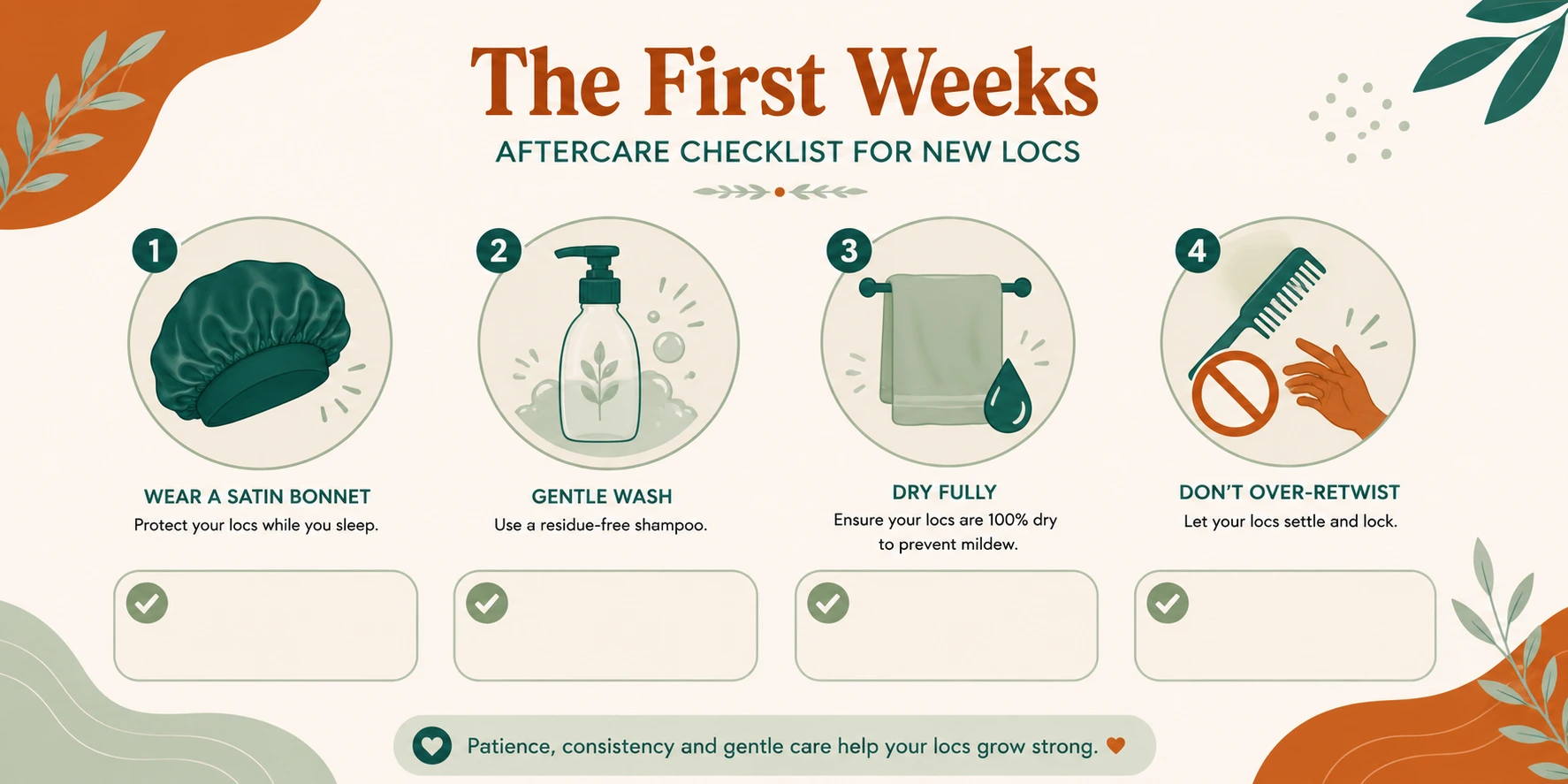
The early weeks are where new starter locs are won or lost, and most of it comes down to leaving them alone more than you’d think.
The biggest one is washing.
With coils, twists and palm-rolled locs, the shape is fragile at first, and washing too soon or too roughly can unravel everything you’ve just paid for.
Follow your loctician’s advice on when to wash, which is often a week or two in for gentler methods, and when you do, be careful rather than vigorous.
Interlocked, crochet and instant locs hold up to water sooner because they’re set from the start, but even those benefit from a gentle first wash. There’s a full method in our guide to washing locs properly.
Keep your scalp clean without over-handling the hair. A clean scalp locks better and itches less, but constant fiddling, twirling and retwisting works against the locking process and can loosen the roots.
It’s tempting, especially in the frizzy stage, but hands off is the rule. If your scalp does get itchy or flaky in the early weeks, our piece on an itchy scalp with locs covers what actually helps.
At night, protect them. Cotton pillowcases pull moisture out of the hair and snag new locs, so sleep in a satin or silk bonnet, or on a satin pillowcase. This is a small habit that pays off across the whole life of your locs, not just the first few weeks.
Go easy on the retwisting. New locs don’t need retwisting every couple of weeks, and doing it too often or too tight is one of the quickest ways to thin your edges and stress the roots. Space out your maintenance and ask your loctician what interval suits your hair. We go into this in how often you should retwist your locs.
And resist the urge to style them too much early on. Starter locs are still finding their shape, and heavy manipulation, tight styles or a lot of product can set them back. A bit of patience now buys you healthier locs later.
Keep your products light and your hair moisturised. Locs don’t need much, and less is genuinely more in the early days.
A light oil to keep the scalp and hair from drying out is plenty; heavy butters and waxes sit on top of new locs, attract lint and dirt, and stop them drying properly after a wash, which is how build-up and smell start.
If your scalp or hair feels dry, a little water and a light oil does more good than a thick product.
When you do wash, make sure your locs dry fully, right through to the core, since damp locs left too long are the usual cause of that mildew smell people worry about. Squeeze out excess water, and give them time and air rather than tying them up wet.
How locs mature: the first two years
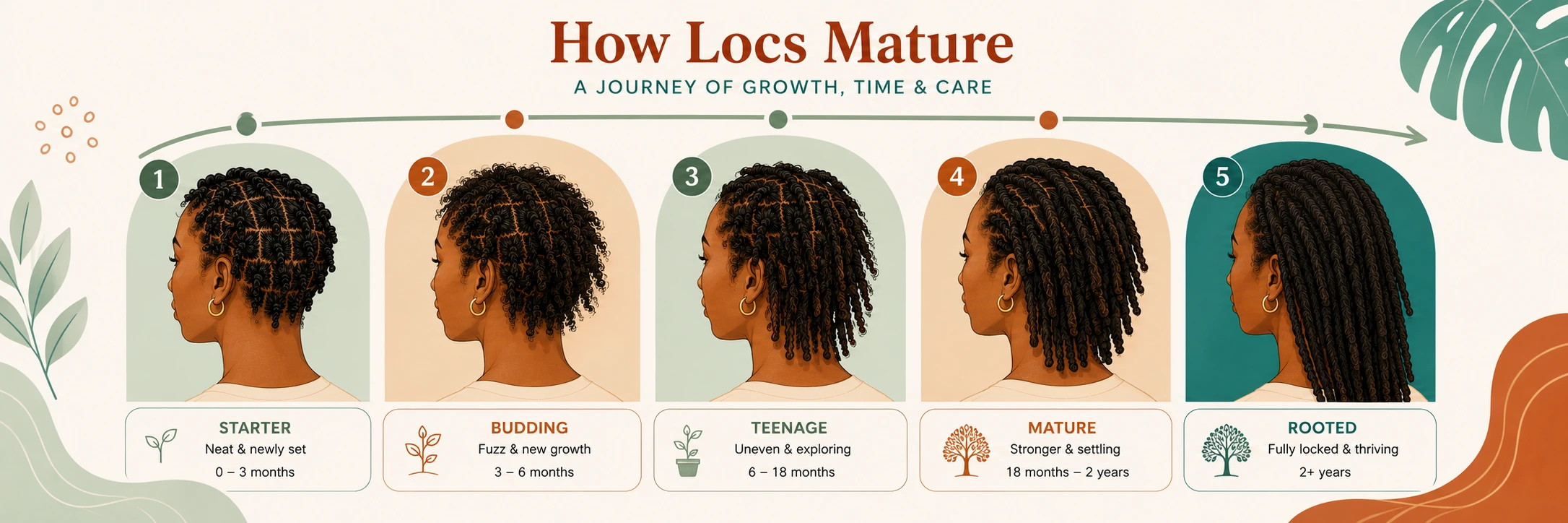
It helps to know roughly what’s coming, so the awkward stages don’t catch you off guard. Locs are usually described as moving through a handful of phases, though the timing depends heavily on your texture, so treat any timeline as a rough guide rather than a promise.
The starter stage is the beginning, when your coils, twists or braids are fresh and still clearly showing the method they were made with. This is when the locs are at their most fragile and need the most care around washing and handling.
From there, locs move into the budding stage, sometimes called the ugly stage, where the hair inside starts to knot and swell and everything looks frizzy and unsettled.
What’s happening is the hair matting and binding on itself inside each section, which is exactly what locking is, but it doesn’t look tidy while it’s going on. Locs may unravel a little at the ends, puff up, and generally look less polished than they did on day one. This is the phase people find hardest, and it’s also the phase that means it’s working.
It’s the stage where a lot of people are tempted to give up or start over, and the advice from almost everyone who’s been through it is the same: leave them alone and push through.
Next comes the teenage stage, where the locs are properly locking but behave unpredictably, doing their own thing, poking out at odd angles, some maturing faster than others.
Then the mature stage, where they hang with weight, feel dense and compressed, and finally look the way you pictured.
Last is the rooted stage, when your locs are fully settled and simply part of you.
How long all this takes varies. Tighter, kinkier hair can move through the stages in under a year; looser or finer hair can take a good deal longer.
As a rough shape, many people find their locs feel genuinely mature somewhere between twelve and twenty-four months in.
For a month-by-month view of what to expect the whole way through, we’ve mapped it out in the loc journey timeline.
Can you make starter locs lock faster?
Not really, and trying usually backfires. Retwisting more often or fiddling with them adds tension and stress without speeding anything up, since locking runs on your hair’s own timescale, set mostly by texture.
What you can do is avoid slowing it down: wash regularly, keep products light, and stop over-handling them. The quickest route through the stages is the low-effort one.
Common early mistakes to avoid
Most of these come up again and again, and all of them are avoidable:
- Parts too small for the hair’s density. Tiny sections on thick hair can be weak at the root and prone to thinning. Sizing should suit your hair, not a photo you saw.
- Retwisting too tight. The fastest route to a receding hairline and stressed roots. Tension should be firm, not painful.
- Washing too soon. On coils and twists especially, an early or rough wash can undo the whole install.
- Over-styling starter locs. Heavy manipulation and tight styles before the locs have set will slow them down and can loosen the roots.
- Fighting your texture. Choosing a method because it looked good on someone with different hair, rather than one that suits your own, makes the whole process harder.
- Heavy waxes and build-up. Thick waxes trap dirt and stop locs drying properly, which leads to build-up and smell. Stick to what your loctician recommends.
When you’re ready to find a loctician
Knowing how to start locs is really about knowing how to pick the right method and the right person for your hair. Once you’ve got a sense of the method you’re leaning towards, or even if you just want someone to look at your hair and talk it through, the next step is finding a loctician you trust.
A consultation costs little or nothing and will tell you whether your hair’s ready, which method suits it, and what the install will cost.
When you’re comparing people, look for starter sets specifically in their photos, not just neat retwists on already-mature locs, so you can see how their fresh installs actually turn out.
Check that they work with your hair texture, ask which method they’d recommend for you and why, and pay attention to how they answer.
A loctician who talks you through the trade-offs honestly, rather than pushing the priciest option, is the one you want.
Reviews from other clients help, and so does a quick consultation before you commit to a full appointment.
The starter locs directory lets you search by city and see who does starter installs near you, with their work, prices and reviews in one place, so you can compare before you book.
Take your time over the choice. The person who starts your locs sets the foundation for years of hair, and it’s worth getting that first appointment right.